Tuesday, July 26, 2011

Working your Way Up to One Arm Chin-ups

It's been awhile since I've written a training article, but you can check out my latest piece in the September issue of Planet Muscle and Bodybuilding titled "Get Pro Level Muscle." The article lists my favorite set extension techniques for every muscle group. Pick up a copy the next time you're at a Barnes and Noble. I just came from Border's, and they're going out of business. Yeesh! Times are tough.

So I got asked on my YouTube Channel if the subscapularis pull-up could be performed on an assisted pull-up machine. Here's how I answered:

This is a very advanced pull-up variation, so you can only perform it if you can do 12-15 real pull-ups (not machine assisted). So I suggest weaning yourself off of the machine and work on upping your reps for real pull-ups and chin-ups. This will take some time.

Let me say that I flat out hate the machine assisted pull-up. For one thing, most people use way too much counter weight and make the exercise so easy that it becomes meaningless and ineffective. You should work on performing actual pull-ups and chin-ups. If you have to use a machine, then use the lightest counter weight possible and struggle through each rep.

All things worth fighting for must be fought for. That means you must struggle somewhat in order to gain and achieve. Your mind and body learn from being physically challenged, and struggling just enough through a pull-up calibrates your nervous system and teaches your muscles to perform the action.

Now in order to learn a difficult skill, you must struggle and succeed, not struggle and fail. Otherwise you calibrate your nervous system for failure. This means you should work on smaller intermediate steps which will lead to your goal.

For myself, I'm currently trying to increase my number of one-arm chin-ups. Now if you start off trying to perform one-arm chin-ups, then you would be completely discouraged by how difficult it is and give up right then and there. So what you have to do is perform and practice the intermediate exercises to one-arm chin-ups.

The intermediate step between 2 handed chin-ups and one-handed is the mixed grip chin-up:


Performing the mixed grip version shifts the emphasis of the chin-up to the side with the supinated (underhand) grip. So one side does more of the chin-up while the other side supports. It's sort of like doing an assisted one-arm chin-up, but without the stupid machine.

Once you're able to knock out several of these, you can transition to one handed chin-ups:


One handed chin-ups are different from one-arm chin-ups. Even though you're hanging by one hand with one-handed chin-ups, both of your arms are still pulling up your weight. Once you're able to do several of these one-handed chin-ups, then you can transition to one-arm chin-ups.

Note: The photo is from the Beast Skills website, which has an excellent primer on how to do a one arm chin-up.

Monday, July 25, 2011

Cardio or Not?

Hey I just got done reading your article "Hypertrophy Training For The Ectomorph: The 10-8-6-15 Program. I'm really excited in trying this method, but I was wondering if I should add any cardio to the workout plan?

Thank You,
T. Patel


My Answer: No you should not add cardio to this program. The program is meant to develop muscle mass in ectomorphs, guys who are incredibly skinny. If you add cardio, then you're adding a lot of physical work that

1) is not going to add any muscle
2) is going to take away muscle if you don't eat enough protein and calories

So ask yourself this, and be very honest: are you skinny or fat? If you're thin as a rail, then quit the cardio, because it's preventing you from gaining any weight. If you're fat, then you're NOT an ectomorph and you should be doing a different program.

Monday, July 18, 2011

Butt-Winking

Dear James,

Your blog is in my opinion the most interesting one that covers all things strength training. Thanks for all you do.

When I do deep squats, I always butt-wink (lumbar flexion when I go below parallel). Do you think this is a problem?

Thanks again,
Ted


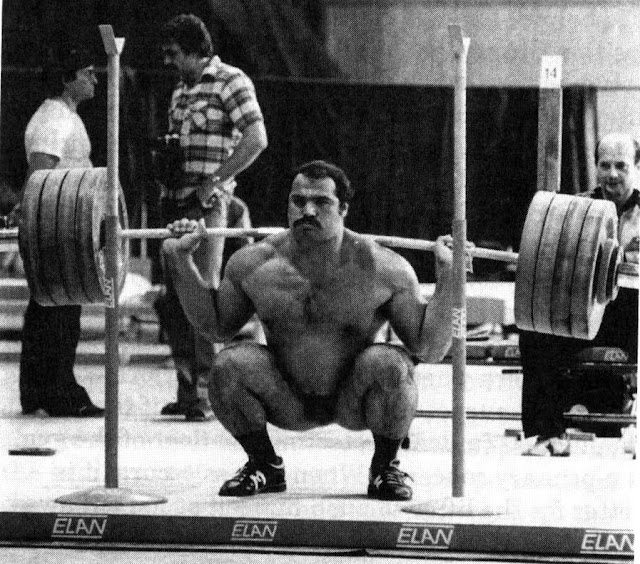
My Answer: Thanks for the high praise, Ted. In short, yes. Lumbar flexion at the bottom of a deep squat is a problem. There are a lot of strength coaches who advocate deep squatting because that is the "proper" way of performing a squat. You develop more muscle when you deep squat as opposed to half squatting or squatting till your thighs are parallel to the floor.

Not everyone can deep squat, however, without rounding the back. Sometimes it's due to the height of the lifter or perhaps he's got a long spine and short limbs. Tight hamstrings, hips and glutes also contribute to lumbar flexion at the bottom of a deep squat. So it's a good idea to stretch these areas if you want to increase squat depth.

The bottom line, however, is that the safety of your back is paramount. Squat performance is secondary. Rounding your spine is OK if you're doing bodyweight squats ass to the grass. If you do one-legged squats, then rounding the back is required.

But performing deep squats with lumbar flexion at the bottom is dangerous, because you have compressive forces (i.e. barbell with weight) on your spine while it's in a vulnerable position. So if you cannot do deep squats without butt-winking, then don't worry about it. Just squat down as far as you can go without butt-winking.

Granted, those of us who can squat ass to the grass will point at you, laugh and call you a girly man. But at least your back will be safe.

Sunday, July 17, 2011

The Critical Drop-off Point

My name is Dan. I'm an ectomorph. I weigh a "staggering" 101.2 lbs. I'm 5'2". My sleep duration is usually less than 8 hours. I'm a student nurse. My schedule is hectic. I can't eat 6x a day. Could you please give me some tips on what and how to eat?

I really liked the idea of following the 10-8-6-15 program. But how about the starting weight of the barbells and dumbells? How heavy should the weights be as a start? I have been to the gym before, but I got frustrated. Your help will really be appreciated.

Looking forward to your reply. Thank you and more power.

P.S. I'm broke. I have no job. I can't really buy your book even though I wanted to. This is the only way for me to ask your help.


My Answer: It's not necessary to eat 6 times a day. What is necessary, however, is that you eat a lot of calories and protein. So if you can only fit in 3 meals a days, then just make sure they're 3 large meals. It is about total caloric intake, not how many meals a day.

As far as what to eat, you should be eating a lot of protein and calorically dense foods. High calorie foods have a lot of fat as well as protein. So that means a lot of meats, eggs, dairy and nuts. Carbohydrates from breads and pastas are fine, since you need the extra calories. But do not make carbs the majority of your food intake. If you think cereal is a good breakfast, then you're in big trouble. You must make meat and eggs the foundation of all your meals.

With regards to starting weight the 10-8-6-15 program, it's simple: start with your 10 rep maximum and add weight as you go from set to set. Substract weight for the 15 rep set. Use a weight that allows you to hit the target rep for each set.

It's that simple.


Hello, I just purchased your book from Amazon. I'm new to all this, so I was wondering if you can help by clarifying the Density and Decompression Workouts.
Let's say for the Chest and Back workout:
  1. neck press
  2. dumbbell press
  3. flyes
  4. pull-ups
  5. seated cable row
  6. side lying rear flyes
Do I go through the whole series of exercises as a circuit and then rest or do I do straight sets on each exercise (i.e. neck press, rest, neck press, rest) until I reach the "critical drop-off point" and then move on to the next exercise?
Thanks
Phil


My Answer: Thanks for purchasing my book, Phil. To answer your question, you will perform straight sets on each exercise. In other words, stick with an exercise and perform set after set until you reach the critical drop-off point. How long you rest is up to you. You may only do 2 sets on an exercise, or you may do 12 sets on an exercise. It will vary from exercise to exercise and it will depend on how long you rest in between sets.

Using the critical drop-off point is what allows you to train instinctively. It will determine the optimal number of sets for YOU on any given exercise on any given day.

Thursday, July 7, 2011

Improving Relative Strength


I have enjoyed reading your book Strength and Physique. I really enjoyed that your focus was on strength. For too long I trained only my "mirror muscles", using as you put it "block head" programs. This lead to injuries and many weak links in the chain. I was wonder if you could help me with a few questions?

How would an athlete train to improve their relative strength and not gain size?

I want to increase the depth of my squat. Should I look at ankle and hip mobility?

Thanks, I look forward to hearing from you.

-Chris Barr


My Answer: If you want to gain strength but not any size, then block training would work well in this regard. If you want to get stronger in a particular lift, then you have to practice and practice frequently. That means doing an exercise repeatedly throughout the week. In order to practice the lift frequently, you have to reduce the volume to a low number of sets: 1-3. High frequency, low volume training is great for strength gains with minimal muscle growth.

There are other factors, of course. If you ingest a lot of calories, then you will gain weight regardless of what program you use, even if it is high frequency, low volume. So keep your calories at a moderate level.

What I suggest is choosing a few select exercises in which you want to improve on. For total body strength, let's say pull-ups, bench press and squats. You will need to workout 3-5 times per week, doing 1-2 sets of pull-ups, bench press and squats every workout. Don't add any other exercises, or you will gain more muscle.

Now your workouts have to be the same, and yet they also have to be different. So even though you will be doing the same exercises over and over, you should vary the grip, width or stance.

Now as far as your squat depth, increasing your hip flexibility will help. I don't find that people can increase their ankle flexibility by much. I would suggest raising your heel ups by putting a couple of plates underneath them and squatting from that position. Doing so in this manner will shift the emphasis of the squat from your glutes to your quads.

What some lifters do for stretching is to squat down with just the bar and stay in the bottom for several seconds to allow gravity to pull them into a greater depth. What I suggest is just do a body weight squat and stay in the bottom position for several seconds. Maintain the arch in your lower back and simply allow your glutes to sink into a lower depth and stretch out.