Posts

Showing posts with the label specialization routines

Pre-Contest Training

Image
Q:  I have really been enjoying your books and making great progress in the gym.  Recently just finished the 14 week mesocycle in  Neo-Classical Bodybuilding , and I'm very keen to start on the body specialization as I have some weaknesses. Just slightly confused how to plug these workouts into the density phase.  Are these workouts purely for density phases only?  For instance Chest specialization workout #2:  Is that just one training session or added onto the T-boost workout?  I guess using the specializations means I'll be training one more day a week?  Thank you very much just slightly confused. Hear from you soon, love the  videos  too.  E. Pascale UK My Answer:  Glad you like the books and videos. As far as the specialization workouts, they are to be used only as a density phase.  Chest specialization workout #2 is one training session.  Workout #3 is the T-boost workout in the chest specialization program. ...

New Article at T-Nation: High Tension, Big Muscle

Image
It's been awhile since I've written an article, but I have a new one at T-Nation titled Create Tension, Build More Muscle . This article goes over how to use strength curve trisets and compound sets to fully blast every fiber for maximal muscle growth. Here's a demonstration of a strength curve triset: Q:  "I have put some of your arm training ideas to good use. I have found your training ideas very effective. I am a blinded vet. I can access your info with the use of 'screen reading' software. "I was wondering about the possibility of an audio version of your latest book? With an audio version of your info, I could get the info independently. I know I would get some great info and effective training ideas. Thanks for all the great info that you put out." Sincerely, D. Allen My Answer:  Thanks for the high praise. Believe it or not, I've actually had a few people request that I do a podcast or release audio versions of my books an...

The "Building On" Technique for Size and Strength

Image
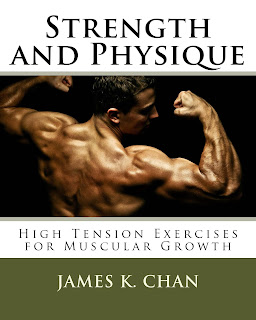
Q:  Hey, I just did 12 weeks of your Building On routine from a few articles ago. I achieved very good results and enjoyed the lifts. A lot different than a standard bodybuilder's routine.  I'm looking for something new now. I want to lift 4 days. Are you familiar with with Doug's mass building routine ?  I value your opinion as what you have said has worked for me. If you are not a fan of this can you suggest something else? I appreciate it.  -Nick My Answer: Doug's program looks like a good one to follow after the Building On routine.  The reason is that the Building On program is an abbreviated workout with very low volume.  In contrast Doug's program is a high volume program, which will build more muscle.  Alternating between high volume and low volume programs is called "backcycling," and it is an effective way to build muscle over time.  I cover this muscle building strategy in my book Strength and Physique: High Tension Exercises...

TRX Chest Compound Sets

Image
JAMES!!!! First off just a huge thank you. Working out is a challenge and fun and at times got me wanting even more! The only question is after 13 weeks of density, volume and frequency training, I am choosing to focus on a chest specialization. How long do I follow that? And how many days a week do I train? My problem area is my center upper chest right before the clavicle. Thanks, D My Answer: Glad you like the workouts from Neo-Classical Bodybuilding . The chest specialization program should be done for three weeks. As you can see in the chart, it is a four day a week program. If you're looking to build up the upper chest, then you should focus on shallow incline presses (20 to 30 degree incline). If you have access to TRX straps, then try chest flyes followed immediately by chest press:

Rest Periods for Specialization Routines

Image
James, Awesome books!!! Workouts feel so productive, and I look forward to the challenges your plans put on me. I was just looking into the chest specialization to use when I get done with my 14 week mesocycle. The question is on workout #2: after the neck press the other exercises do not show any rest periods. Same thing on workout #4. Are they to be done one after the other and then loop back to the first exercise? Thank You, D My Answer: In general, if there are no rest periods designated, then rest periods are up to you. For the chest specialization routine, all other body parts are on maintenance training, which means 3 sets of 6-8 reps with no strict adherence to rest periods. To keep things consistent, however, do the neck presses in workout #2 with 90 seconds rest, then do the other exercises with 90 seconds rest as well. Rest 90 seconds for all exercises in workout #4 also.

Neo-Classical Bodybuilding Specialization Routines

Image
Q:  I am going to start training with your suggestion from Book Two : Building a Bigger Engine. I see that you indicate to do it 3 times a week. Is that all the training in a week and no specialization? And how long would you suggest training that program? Then, where do I take it from there? The Hypertrophy Training for Ectomorphs ? Thank You, D.T. Stipetich My Answer: I was very specific about what to do. Follow the Building a Bigger Engine program a 3-4 weeks. Then switch to the Neo-Classical workouts . There is no specialization with the Building a Bigger Engine program. If you want to specialize on a body part, then choose one of the specialization programs in Neo-Classical Bodybuilding and do that after the main Neo-Classical program. You should not be doing the Hypertrophy Training for Ectomorphs program, because you need to focus on fat loss, not muscle gain. You have to prioritize your training, and that means focusing and accomplishing one goal at a t...

New Article: Controlled Overtraining for Muscle Growth

Image
I have a few articles out there in queue with a number of magazines. It's hard to keep track of them, so every so often I'm surprised when I see one pop up. Most mags don't let you know if they're going to print your article or not. One time I went to a Barnes and Noble, picked up a mag and thought to myself, "Here's this stupid ass magazine that didn't want to publish my..." [thumbing through the pages] "... well what do you you know? They picked up my article! Aww, that's great... Hey wait a minute... they didn't pay me! Those cheap, thievin' bastards." Of course, at the time I was new to freelancing and didn't know that mags pay after the article is in print or online. Anyway, I have a new article at T-Nation: Controlled Overtraining for Muscle Growth

New Article at Bodybuilding.com

Image
Just a quick update: I have a couple of new articles at Bodybuilding.com: A Program for All Seasons Power Bodybuilding    This article is an online reprint of a Planet Muscle article.  It addresses training for the entire strength spectrum: explosive power, maximal strength, hypertrophy and strength endurance.  Also, Tactics and Strategies is currently unavailable. It'll be re-released soon with some additional chapters, including a chapter on ab training, which a lot of readers have been asking for. Anyway, on that note, let's answer some reader questions: Q: Hello. About the Post Exhaust Routine: Is it twice a week? Workout 1 on Monday and Workout 2 on Friday? My Answer: Hit each workout twice a week. So Workout 1 can be done Monday and Thursday, while Workout 2 can be done Tuesday and Friday. Q: I just read one of your articles on Bodybuilding.com, and I was wondering if you could help me with something. I have been riding BMX for about eight y...

Muscle Specialization Programs

Image
  Q:  Hello, I'm following the 20 pull-ups training program and am training pull-ups Monday, Wednesday and Friday.  Is it safe to do other biceps exercises on Monday and Friday? Or should I leave out any other biceps exercises? I did 4 sets of curls yesterday, and it didn't seem to hurt. I did them about half an hour after the pull-ups and did squats in between. -CS My Answer: It shouldn't be a problem. In general when you do a specialization program, you'll need to put all other body parts on maintenance mode. So if you're doing a specialization program for pull-ups, then you have to scale back on your sets for body parts other than the back and biceps. That means 3-4 sets each for chest, delts, quads, hamstrings, calves and triceps during the pull-up program.

New Article: Pivot Point Training

So check out the November/December issue of Planet Muscle. I have an article titled "Pivot Point Training," a follow-up to my T-nation article The Shotgun Method . Pick up a copy the next time you're at the supermarket or bookstore. Anyway, I get questions all the time about training, but here's one that even surprised me: "I have just recently completed certification for training, and I have a training interview for a local gym, and they want to design a 30 minute workout. The person comes from an athletic background, general fitness and wants to lose about 10 lbs. No injuries to worry about. I was wondering if you could help me with an exercise plan that would help me do well for this test?" Thanks, Jake My Answer: Jake are you paying me to write up this program? You just got certified as a trainer, but you want me to write a training program? I don't know what certification you've got or what your training background is, but yo...

Analysis of HST

Image
HST or Hypertrophy Specific Training is a popular training program, partly because it has a marketable name. For those of us who are more concerned with mass (and not so much athletic performance), then a name like Hypertrophy Specific Training will raise a lot of interest. HST is the brainchild of Bryan Haycock, and it espouses these principles: Train each body part every 48 hours, or basically three times per week. Increase the weight each and every workout. Decrease the reps every two weeks. Decondition the muscle before you do it all over again. There's more to it than that, but those are the basics. For instance, HST prescribes 2 sets per exercise. Here's my take on HST: 1) The high frequency of training is good for size. For gaining, retaining and building on what you've gained in size, it is always better to train more frequently (3-4 times per week). For high frequency training, then HST fits the bill. 2) Two sets per exercise really doesn't incur as much grow...

Analysis of MAX-OT

Image
I've tried every program out there on myself and on my clients. People search for the perfect program, one that will continuously give them results in size and strength. There is a constant search for this holy grail of bodybuilding.  I've done 15 years of training, and I've realized this: all things work to some degree, but all good things must come to an end. You can choose a program, and it will give you results, but only for a short while. Every program has its pros and cons. Max-OT is no different. The parameters are really simple:  6-9 sets per body part  4-6 reps  2-3 minutes rest between sets  No more than 30-40 minutes per workout Train each body part once 5-7 days I like this program, because it is nice and simple, but it produces results. I find this program is great for clients who cannot figure out the concept of periodization. This program is also great for people who are fast-twitch dominant.  The con, of course, is that if you're slow-twitc...

Article at T-nation.com

Image
Q:  "Hey James, I read your article on  Training for Ectomorphs  and have decided to give that routine a try, as I have had trouble gaining on other routines. I was just wondering what your thoughts are on failure and whether or not I should be training to failure on any of the sets?" Much appreciated, Dan My Answer:  Well, it depends. If you are completely new to strength training, then going to failure would be good. A newbie needs to develop those neural pathways. However, if you've been seriously training for years, then going to failure would not be a good idea. Intermediate to advanced trainees can tap into larger motor units much better than newbies, because they have been training for a while. If they were to train to failure, then they would exhaust their nervous systems much more than a newbie and their recuperation period would be much greater. This is why really big guys tend to use split routines where they train each body part once or twice a week. What...